Author Archives: admin

Yulii Engel Biography of Scriabin Chapter II

II. School years

(1882–1889) Why Scriabin joined the cadet corps – Comrades and seniors in the corps, their attitude to him – His health and successes – A certification from 1885 – First public performance as pianist – Piano lessons with Gyorgi Konyus – Nikolai Zverev, his students, musical evenings. Nocturne in A flat, 1884 – Work on musical theory with Sergei Taneyev and Gyorgi  Konyus – Konyus’ observations of Scriabin – Monigetti – Features of Scriabin’s compositional habits at that period – His helplessness in everyday life.

Thus, in those quiet, feminine surroundings, Scriabin’s life was spent until his tenth year. The little boy, as is usual with children of his age, learned little by little to study, ‘to practise’, but essentially he grew up in freedom, at leisure, with the possibility of devoting himself to whatever he was instinctively attracted to; his relations encouraged him in this, and delighted in it. But finally it was time to think seriously about choosing an educational establishment.

Scriabin’s father would have liked to send the little boy to a lycée,[1] but the child eagerly begged to join the cadet corps. And ‘when Sasha begged like that it was impossible to refuse.’

Of course the child’s desire was based, not on an inclination for military affairs but above all on the living example of those around him. All Sasha’s uncles were cadets; the youngest of them, Dmitri Alexandrovich (then still known as Mitya) was only six years older than his nephew. The child used to listen to their tales of life in the corps, took part in their leisure activities, listened to the music they made. The example of Mitya, who loved the corps (at that time the corps were considered superior to the gymnasia[2]) had more influence on the child than anything else, and was the cause of his request to join the cadets.

It was Sasha’s aunt, Lyubov Alexandrovna, who prepared him for the entrance examination. The little boy got on with the subjects quickly and easily. In the examination itself he came out (15) top of seventy entrants, and in his tenth year, in the autumn of 1882, was ready to join the first class of Cadet Corps no. 2 in Moscow (which is in Lefortovo).

In this corps the Scriabins may be said to have been a fixture. One of them, Vladimir Alexandrovich, an uncle of Sasha’s, was a tutor here at this time and lived in the building itself. The little boy moved in with him. Thus Sasha, though living in the corps building, was one of the day boys and grew up in  familial surroundings.

At holiday periods the little boy was usually sent home, to his grandmothers[3] and his aunt and it was there that he spent the time until his return to the corps. Two to three years after Alexander joined the corps, the Scriabins sold the family home (as was inevitable after the death of the head of the family) and moved into Lefortovo itself, to another of Alexander’s uncles, who was a tutor in Cadet Corps no. 1. Both the corps were situated near each other, so that Alexander was now very near both to his grandmother and his aunt.

Skryabin’s gifts were soon noticed both by his comrades in the corps and by the teachers. The comrades were very fond of the ‘cadet by chance’, as they soon started to call him. The did not even beat him in the first days, as is customary with all novices according to the ritual of the corps. Alexander’s gentle disposition, his resourcefulness in devising amusing pranks, his brilliant abilities and his musical talent meant that most people liked him and even made for a wide popularity within the corps. When he played the piano in the evenings, his comrades listened eagerly to him and sometimes requested this or that improvisation. His verses, too, excited interest.

The daughter of the corps director, A. F. Albedille, took especial interest in Alexander; she was a great music-lover and a musician herself. She played duets with him and when he  was ill, as sometimes happened, she took care of him.

If we add to all this the influence of relations serving in the corps we can understand the exclusive position which Skryabin occupied in the corps. Every kind of allowance was made for him, and he was excused completely from some duties (from shooting, sometimes from drill, but not from gymnastics). They did not even make him struggle over military theory, in which he  took little interest.

Allowance was also made for Skryabin over the state of his health. From birth he had not been robust, and this persisted during his time in the corps and indeed throughout his life. He never went through the usual children’s diseases easily. At the age of twelve he suffered a very serious illness. Measles were complicated by dropsy, and the child was near death. Doctor Pokrovsky, who treated the sick child, said that there was hardly any hope of recovery, but that he would try one extreme measure… And this measure helped.[4] One summer, Skryabin was taken  to Samara to drink kumis[5] because of his weak lungs. He was also taken for a summer to the Crimea.

While all this was going on Scriabin studied at the corps very well. He did every task with his usual care and exactness; indeed, with his gifts, everything was easy for him. In the lowest classes he even won year prizes, but after that no further prizes were awarded to him – firstly, because he was devoting himself increasingly to music, secondly, because the management  considered that those who would follow a military path were the ones needing prizes.

A report on Scriabin’s results in class four of the corps has been preserved.[6] Here is the substance of that report, addressed to his grandmother:

                        Dear Madam

                                    Elizaveta Ivanovna!

            Your grandson, cadet in class four, obtained the following results in the most recent certification:

            Divinity:                       11

            Russian language:           9

            French language:            12

            German language:          10

            Algebra:                        9

            Geometry:                     10

            Natural history:              12

            History:                         10

            Geography:                    8

            Drawing:                       8

            Average mark:               9.8

            Position in class: 1st out of 22 persons

            Conduct: Good, although in the strict sense one should not put it that way, as in

            this year he has been more neglectful in preparing tasks.

            Teacher: College counsellor V. Matskevich.

From this certification it is clear why Scriabin, having been a brilliant pupil, became a good one, and why ‘in the strict sense’ that happened.[7] But with the average result of 9.8 (according to a twelve-mark system) he remained first in the class, nonetheless; obviously, this was the highest mark.

In the very first year of his time at the corps, Scriabin made an appearance as pianist in a corps soirée, which took place with the closest collaboration of A. F. Albedille, who was mentioned earlier. He played a gavotte by Bach, and he played this, like almost everything at that time, without having obediently studied from the printed music, but principally by ear, having listened to how others played it. Thus, one cannot say that it was academically pure Bach; there was also something in it of the pianist’s own. At the end of the piece the little performer even hesitated, but did not get lost by any means; and he improvised, in an orderly way, a few chords of his own which were necessary for an ending. At about the same time Scriabin also played a ‘Venetian Gondolier’s Song’ by Mendelssohn.

In the summer of 1883 Scriabin started for the first time to take actual ‘lessons’ in piano. It was Gyorgi Eduardovich Konyus [Conus] who became his piano teacher. Konyus is now [1915-16] a professor at Saratov Conservatoire, a theorist, composer and pianist.[8] At that time Konyus was himself still studying at Moscow Conservatoire. He was twenty, and had just moved from class six to class seven in Paul Avgustovich Pabst’s piano class. Konyus was living at that time by the Nikolaevsky railway track, in the village of Khovrino. Here is his own account of his work with Scriabin.

A lady whom I did not know came to me (it was Lyubov Alexandrovna) and asked me to give lessons to an eleven-year-old boy,[9] who turned out to be Sasha Scriabin. He lived with his grandmothers[10] – as I remember, they doted on him – near to me in a place where there were many dachas, which had the same name as the village: Khovrino, near to the same railway line, in the neighbourhood of a whole series of ponds with picturesquely wooded banks, above which the songs of nightingales resounded incessantly.

The child was frail in appearance. He was pale, small in stature, seemed younger than his age. He      turned out to know not only notation; he knew the scales, the tonalities, and played something   to me with little, weak fingers which could hardly press down the keys. I don’t remember what it was exactly, but it was played accurately and with a satisfactory flow. His stage of preparatory development can be approximately understood by his having played Weber’s Perpetuum mobile op. 24[11] as one of the first pieces we worked at together. He learned pieces quickly, but his playing, I remember, was always insubstantial[12] and monotonous – probably owing to physical insufficiencies.  I regret that I cannot say exactly what else we worked at together. But, probably, I will be right in saying that having learned the scales in all keys and all kinds of technical exercises and arpeggios he played the easier Cramer etudes, pieces by Mendelssohn and short miniatures by Chopin.

I worked at the piano with Scriabin all through the summer of 1882, and then, after leaving the         summer dacha behind, continued lessons with him in Moscow [18] throughout the winter of 1882– 83, probably stopping before the exams.[13] At that time Sasha was living in the cadet corps  (the second or the fourth – wearing the well-known blue uniform) with his uncle, who was a teacher in the same corps. I remember that all through the winter I set out every Thursday at four from the Nikitskaya,[14] where I had furnished rooms, to Lefortovo by horse-drawn tram, devoting more than an hour to the journey itself.

At that time there was not even any talk about Scriabin’s joining the Conservatoire as yet. He was following his own inclination in working at music but preparing for a military career. From my own conversation with Alexander Nikolaevich’s grandmother (while he was still in the country, at Khorvin) I remember that she told me several times that A. N.’s mother, who had died early, was unusually gifted musically and played remarkably well. I do not know with whom Scriabin studied before me. But there is no doubt that he had worked with somebody.[15] Later, in the spring of 1883,   [1884?] I lost touch with Scriabin.

Scriabin was left to his own devices as a pianist for a while, and it was at that time, clearly, that the decision finally developed within him to enter the conservatoire. In order to prepare for this he began to take private lessons in piano playing with Nikolai Sergeievich Zverev, a teacher at the conservatoire.

Zverev was an ‘old-fashioned gentleman’, from the time when it was considered that the study of music was only acceptable in an amateur way for a ‘decent person’, not as a profession. He studied piano playing with Dubuque and Henselt[16] and was a fine pianist, but he turned to teaching only under the pressure  of external circumstances, after he had happily made his way  through a large fortune. He taught at the Moscow Conservatoire from 1870 until his death in 1893.

Some pupils lived in the house with Zverev with bed and board. At that time, when Scriabin started working with Zverev, the following were boarders of this kind destined to become Conservatoire pupils: Sergei Rachmaninov, Matvei Presman (later, director of the music college at Rostov on Don and a professor at the Conservatoire of Saratov), Leonid  Maximov (a brilliant pianist who died in 1904, a professor at the college of the Philharmonic Society).

Amongst Zverev’s private pupils, the following were outstanding: Chernyayev (son of the hero of the [Turkestan] war of 1887-88[17], now an officer of the Guards), and Dukhovsky (later, a public prosecutor; now, a presiding attorney).[18] […]

Emilii Rozenov,[19] himself a pupil of Zverev at one time, characterises his teaching methods thus:

At that time there were absolutely no teachers with musical-critical training – analytical teachers. Nor was Zverev, that kind of teacher and in that sense his teaching might be described as routine. But amongst teachers of basic technique (and this was Zverev’s role in the Conservatoire) he was one of the best. From his school emerged such pianists as Siloti, Rachmaninov, Maximov, Pressman and others, all magnificently equipped in a technical sense – and that itself is significant.He knew as no-one else did how to impart discipline in technical work, how to teach students to practice seriously. Zverev’s boarder-pupils had to get up at six in the morning, clean their clothes and shoes themselves, and make the bed; after that they sat down to play. There was to be no sloppiness or time-wasting about this; otherwise, Zverev’s shout, friendly but strict, would immediately resound from where he sat in a neighbouring room with a long speaking-tube to his mouth: ‘Ma (Zverev’s name for Maximov), stop improvising!’ ‘Mo (his name for Pressman, short for Motya), play clearly!’, etc. With all of this, Zverev valued any sign of musicality highly – indeed, he was moved by it. His pupils loved him as if he were their own father, and obeyed him unconditionally.

Zverev retained from his former wealthy life not only a fondness for ‘the pleasures of the table’ but also a love for the company round the table. On Sundays he would arrange dinners (long, abundant and delicious, as a partaker narrates) to which were invited Zverev’s best pupils and his closest musical acquaintances. There were, besides the just-mentioned pupils, also professional pianists: S.M. Remezov (now [1915–­16] a professor at the Philharmonic college) and Szymanowski (later a teacher of theoretical subjects in Moscow), Dr. Sadkevich, the Conservatoire doctor ­and a great lover of music, and others.  Sometimes Tchaikovsky himself was there; Zverev, while already a teacher at the Conservatoire, had at one time taken lessons from him in musical theory.

Scriabin, too, was a constant Sunday visitor to Zverev for a fairly long time, one of the youngest to have been there. As a day boy, Skryabin could not be as familiar with his comrades who boarded with Zverev as they were amongst themselves; moreover, he was younger than them. But, in general, relations were good.  He was on more intimate terms with Chernyayev than with the others at that time. Among other things, their acquaintance was renewed in Petrograd many years later, about two years before Scriabin’s death.

After dinner, which was impressive as regards the portions both of food and of drink, a musical evening always took place in which pupils of Zverev appeared before an audience of their school fellows and the guests. Scriabin, too, played there. Zverev loved him and called him  ‘Skryabushka’, but valued the pianist in him more than the composer. According to his comrades’ accounts, Scriabin was already a splendid pianist at that time. He played the Schumann Paganini etudes, for example, magnificently, especially the final one in E major.[20]

Sometimes Scriabin also played his own compositions, as did Rachmaninov. Even then, at the age of fourteen, he enjoyed among his close acquaintances the reputation of a talented, highly promising composer in the spirit of Chopin. At that time he loved Chopin’s music passionately.

Sometimes he would put a few works by Chopin under his pillow at home, so as not to be separated from them even in the night. The compositions of Skryabin which he played at Zverev’s establishment were also in the line of Chopin: etudes, waltzes and mazurkas. Some of them, without doubt, were sketches – and especially significant in their formation – of works published later.

It was evident to us that Skryabin played even Bach and Mendelssohn differently from the principles imparted in authentic piano pedagogy. With him, his native instinct took precedence over the skills of training. It was the same, though in a much more pronounced way, in the area of creative composition.

It is difficult at the moment to establish exactly when Scriabin began to take lessons in musical theory (‘composition’). We only know that his first teacher was Sergei Ivanovich Taneyev, and that these lessons began two or three years before Scriabin entered the Conservatoire, apparently in 1885. This is the most likely year, but the possibility cannot be excluded that it was in 1884.

But Scriabin had composed a considerable body of work even before he began to work with Taneyev. And he did not just improvise his works, but also wrote them down. In no. 13 of the journal Muzyka, 1913, there is a nocturne by Scriabin dated 1884, when the composer was thirteen.[21] This nocturne (in the spirit of Chopin) is above all excellently laid out in a pianistic sense: it was born from the piano and sounds extremely well. Moreover, the flair for form, harmony and voice-leading is startling in a boy of thirteen who had not ‘studied’ these things.[22]

And it is evident from some curious musical orthography that he had not ‘studied’ them, for example: D flat instead of C sharp,  C flat instead of B natural and even E double flat and B double flat instead of a simple D and A  (in the third and fourth bars of the section in C major).[23] Even if this nocturne was written after studies with Taneyev began, it must in any case have been at the very earliest stage.

What follows is Sergei Ivanovich [Taneyev]’s own account of this beginning:

            One spring – I don’t remember which year, my memory for dates in years is poor – General             Nikiforov[24] came to see me, and he said: ‘May I bring a young, talented musician to see you?’ ‘Do bring him.’ They brought a young cadet, small, thin and fragile. I tested his ear –the ability was outstanding and obvious. I began to work with him a little,  introduced him to various elements: forms, the sentence, the period. Getting on towards September he wrote a few pieces,         and they were all very pleasing. A genuine talent could be discerned. Then we worked on       harmony for a year. There was already talk of his entering the Conservatoire; in order to prepare for             entry there, I recommended him to study with Gyorgy Eduardovich Konyus. He did so, and began      to work with Konyus at counterpoint, among other things.

            That summer I was living at Demyanovo, near to Klin. The Scriabins’ dacha was also situated not      very far from there, in Maidanovo, I think.  One time, while out for a ride, I came across           them at the dacha and took Alexander Nikolaevich back with me to see how he was getting on. I sat           him down in the park under an oak tree and set him some counterpoint to write. He’s sitting and writing, and young people (especially girls) walk around him and complain: ‘Poor little fellow, what wonderful weather, and instead of taking a walk he’s writing some counterpoint or other.’ Then, when I let him go, they caught up with their favourite and all of them went for a pleasant walk.[25]

That is all that Taneyev managed to tell me of his pre-conservatory work with Scriabin. The following reminiscences by G. E. Konyus may serve to fill in the gaps in this fragmentary account.

            Between the years 1887 and 1889 (again in spring), when I was living near Ostankino, in the place    known as ‘Panin’s Meadow’, Scriabin came to me with the request that I should work on harmony with him.  He started visiting me once a week, and thus we completed a course of harmony  by the summer. I can add the following observations which remain vividly in my memory from these   studies, and concerning the incredible speed with which we completed the course. It was not necessary for me to teach Scriabin harmony in the generally accepted meaning of the word, i.e. to develop and explain the subject, to illuminate the complicated aspects, to educate him harmonically or to inculcate correct progressions, to warn of incorrect ones or, even less, to train him and make him practise this or that method of resolution, modulating sequences etc. Everything of that sort which is required of a musician lived its own self-generated life within Scriabin, was prepared by nature herself. For the most part it remained for me only to attach theoretical labels (names, terms,   etc.) to what revealed itself as Scriabin’s innate knowledge. Usually I did not have to complete my explanation. Scriabin guessed instinctively from my first words what was being discussed, interrupted me and completed the account himself. Only such phenomenal quick-wittedness could explain the short  time – two to three months – in which he managed to complete the subject.

Despite prolonged efforts to recall how Scriabin wrote exercises, this has completely disappeared from my memory. This circumstance prompts me to ask myself: ‘Did he actually write down exercises?’ It is extremely likely that these were done during the lesson, directly at the piano.

The accounts by Taneyev and Konyus provoke some puzzlement: Why (unless this is just a slip) did Taneyev arrange his work with Scriabin in an unusual order? That is to say, he did not start with harmony and then form, but the other way round. Why did Konyus not know that Scriabin worked at harmony with Taneyev before he went to Konyus, and if he did know, why does he not refer to this in telling of Scriabin’s remarkable progress? Why does Taneyev say that Konyus worked with Scriabin at counterpoint, whereas Konyus speaks only of harmony? In reply to my request, G. E. Konyus clears up these perplexities thus:

It is evident that one must remember that for a year Scriabin went through harmony with S. I. Taneyev.[26] But from the succession itself which Sergei Ivanovich recounts: first some acquaintance with forms, then  harmony, it is clear that Taneyev was not leading Scriabin down the stereotyped routine path of the Conservatoire instructional plan, but teaching him in conformity with Scriabin’s own degree of talent and capability of quick learning. The characteristics of a pupil who impatiently rushes ahead, together with the tact of a pedagogue who understands that unnecessary holding back over details or dry harmonic exercises could only be harmful to such a nature as Skryabin’s, could not fail to suggest to Taneyev some modification of the usual method of teaching. To be precise, a practical knowledge of harmony needed to be acquired, partly at the piano, partly from written exercises which in their content were closely related to the student’s creative work, and by the same token removed from so-called classroom exercises.

 As a result of such a method of organising the work, Sergei Ivanovich could not but be assailed by doubts when the question arose of Skryabin’s entering the Conservatoire: might not the student still suffer from gaps in the harmonic knowledge which corresponds, as a whole, to the demands of the programme for entering the Conservatoire according to an examination in counterpoint? If we now remember Sergei Ivanovich’s extremely scrupulous conscientiousness, it becomes clear that he wanted to test whether a slightly unusual method of procedure in going through the preceding discipline of counterpoint had left gaps in Sasha’s harmonic education. Sergei Ivanovich himself worked eagerly in the summer (on composition and also on his Moveable Counterpoint)[27] as in winter he moved on to his lessons. It is probable that it was because of not having leisure himself that he sent Sasha to me in order to prepare for the examination. Thus Scriabin studied harmony at first with Sergei Ivanovich and before entering the Conservatoire practised with me for the examination. But he probably did not take the exam itself, for in relation to entering the          Conservatoire Taneyev had established a tradition of  exempting those whom he considered capable of entering his counterpoint class from the official examination.[28]              

In any case, in the years preceding entry to the Conservatoire – at the ages of 13, 14 and 15 –

Scriabin did not only compose a great deal, but, as is evident from the above, enjoyed the reputation of a highly promising composer. And that was how he was regarded, not only in the Zverev circle of musical specialists.

The young composer’s works met with even greater attention, indeed with outright enthusiasm, in the family of I. Monighetti, the institute doctor. He was often driven there on Sundays, even in his earliest years. In the family Monighetti, which consisted of father, son and two daughters, many young people gathered and life was merry, warm-hearted and noisy. Both sisters loved music, as did their parents; one of them graduated later from Pabst’s class and played Scriabin’s works excellently.[29] Scriabin felt at home in the Monighetti house, and this pleasant feeling stayed with him throughout his life.[30] He was always spending time with them, took part in all the entertainments and pranks, often played or improvised and introduced them to all his new works.

He was particularly eager to play his new works – even if they were in the condition of a sketch or just an embryo, a theme, a motive. This feature was characteristic of him throughout his life to the greatest extent with those who were the slightest bit interested in his works.

It is curious that in order to compose Scriabin had no need to be alone. Quite the opposite: a habit, remaining from childhood, of never staying alone, here too was preserved in full force. During the entire time of composing he did not like to remain alone, and when there were times in which he ‘composed day and night’, this concern of his assumed special proportions. He would invite his grandmother (or his aunt) ‘to sit for a while on the little divan where Sasha was working.’ Later a pillow was produced, and the little divan was transformed into a bed. And grandma did this with the greatest eagerness: in her own words, ‘one never slept so well as with the sounds of Sasha’s “composing.”’. It remained thus quite late on, even in the Conservatoire years.

By token of the same habit of not leaving the boy alone, for a long time – until his fourteenth year – allowed to go out by himself. Someone always accompanied him, most often his aunt Lyubov Alexandrovna. In the first period of study with S. I. Taneyev it happened that Sergei Ivanovich himself took on this role of ‘Sasha’s tutor’, taking his young student to the Skryabin’s house in the Zlatoustky pereulok, from whence he was later sent to the cadet corps. This was even the case when Scriabin was in his fourth year at the corps. On one occasion it came about that  he had to go to Kuznetsky Most alone for some sheet music, and there the driver of a horse-drawn vehicle ran into him, knocking him off his feet and breaking his right collar-bone. During his recovery Scriabin did not waste time, and practised at the piano with his left hand alone. But, of course, this incident could not strengthen his belief in his own practical independence and circumspection.


[1] There were four of these higher education facilities in Russia at that time: in Yaroslavl, Saint Petersburg, Odessa and Moscow. The first-named specialised in law.

[2] Secondary schools.

[3] See Chapter One; the second ‘grandmother’ was in reality a godmother.

[4] Thanks to Dr. John Bradley for this comment on Engel’s rather reticent account: ‘I  suspect that measles was complicated by pneumonia and pleurisy which would be likely to cause a pleural effusion, i.e. fluid in the chest, which might have been treated by attempts to drain the fluid by inserting a needle into the chest wall.’

[5] The fermented milk of a horse or ass.

[6] The report is dated December 21 1885. As there were seven classes in the corps, and Scriabin never stayed down for a second year, his years of attendance at the corps were 1882–89. Y.E.

[7] It is characteristic of the later Scriabin, and of the letters to Natalia Sekerina of the 1890s, that he obtained full marks in French and in natural history, and a high mark in divinity.

[8] Konyus had taught at the Moscow Conservatoire from 1891–99. He returned as a professor in 1920 and continued to teach there until his death in 1933.

[9] Scriabin was then not quite ten and a half years old. Y. E.

[10] See note 3.

[11] This is the finale of Weber’s sonata in C major. The choice of piece shows that at this early age Scriabin had plentiful dexterity and fluency, if not the strength to give the work the dynamic range it needs.

[12] Konyus’ term is ‘ethereal’, and later this was to be regarded as the special quality of the mature Scriabin, but for a teacher imparting basic technique a firm, clear tone would be a desideratum – the ‘ethereality’ was regarded as a shortcoming, and sometimes criticised later in reviews of concert appearances.

[13] It is clear that all these dates need to be transferred to the following year. Scriabin performed a Bach gavotte in the corps in the academic year of 1882–83; this was still during his study with G. E. Konyus. Accordingly, these studies began in the summer of 1883 (not 1882) and continued in 1883–84 (not 1882–83). Y. E.

[14] Probably the Bolshaya Nikitskaya, where the Conservatoire is situated.

[15] The earlier part of the account makes it clear that Scriabin studied a little, only with his aunt. Y. E.

[16] Alexandre Dubuque, 1812–1898, Russian pianist of French descent, a pupil of Field. Adolphe von Henselt, 1814–1889, German pianist and composer. He studied with Hummel in 1832; Liszt praised his ‘pattes de velours.’ He became the court pianist to Alexandra Fyodorovna, Empress of Russia, in 1838, and had very considerable influence on the system of musical education in Russia. At the end of his life, from 1887–88, he taught at Petersburg Conservatoire.

[17] It is possible that Engel has confused his history here. Mikhail Grigorievich Chernyayev (1828­–1898), was known as ‘The Lion of Tashkent’ after a daring but unauthorised exploit in 1865. He was honoured as a brave officer but  ordered back from Turkestan for disobedience to command. He was Governor-General of Turkestan from 1882­–1884, but took no part in the conflict of 1887­–88, having retired in 1886. http://hrono.ru/biograf/bio_ch/chernjaev_mg.php accessed Nov. 16 2020.

[18] The latter rank was, under the law reform of Alexander II and until 1917, that of an attorney at a district court, dealing with serious civil and criminal cases.

[19] Emilii Karlovich Rozenov (1861-1935), mathematician and musician, musicologist, critic, and pianist. Like Scriabin he studied with Zverev (but at the Conservatoire, not Zverev’s private school), Safonov, Taneyev and Arensky.

[20] In the Schumann Studies after Paganini Caprices, op. 3, the study in E major is No. 2. It is likely that the work referred to is the Six Concert Studies composed after Paganini Caprices, op. 10. In this set, another study in E minor and major has the final place. The minor section which starts the piece returns at the end, but in the centre is a long and brilliant section in E major.

[21] Reprinted in the complete edition, volume 1 (1947), p. 220–223. The editors give the date 1884–1886.

[22] Only the last line, as a transition to the da capo, is not particularly well organised. Y. E. [the complete edition prints out the da capo complete. The passage referred to by Engel is in the second system of p. 222 in the edition mentioned, Lento.]

[23] These recondite examples of orthography may be regarded as the ancestors of similar examples in the late works which have been studied by George Perle (‘Scriabin’s self-analyses’), Music Analysis 3/2 (Jul. 1984), p.101–122, and Cheong Wai-Ling (‘Orthography in Scriabin’s late works’), Music Analysis 12/1 (Mar. 1993), p. 47–69. The young composer was perhaps working out his harmonies from the bass up and regarding them as modifications of simpler harmonies – perhaps, not so far from his later method.

[24] There is a very distinguished present-day general by that name (a descendant?) but it has not been possible to trace the general referred to by Taneyev.

[25] Judging by this account and by the fact that Scriabin entered the Conservatory in January 1888, it is a credible supposition that Taneyev first met Scriabin in the spring of 1886. Taneyev ‘introduces him to elementary subjects’; towards autumn Scriabin wrote a few pieces, then came a year of study in harmony – up to the spring of 1887. This was followed by study with G. E. Konyus in the summer and autumn of the same year and entry to the Conservatory in January 1888. Lyubov Scriabina relates that Alexander was thirteen or fourteen when he started studying with Taneyev. From the above account he must have been fourteen. Y.E.

[26] Konyus writes to me: ‘I had completely forgotten about this. In the first place, I did not know that Scriabin turned to me on Taneyev’s advice. I learned this much later. And I was reminded by Scriabin himself even of the very fact that he studied harmony with me – and not so long ago. I had forgotten this because of its being so long ago and because of the abundance of pupils I have taught, and only gradually remembered all the details of which I told you. Y. E.

[27] Podvizhnyi kontrapunkt strogogo stilya, 1909. The usual English expression is ‘invertible counterpoint’. Taneyev’s title, which expresses the matter more accurately, is translated directly in most scholarly discussions. The full title of the English language version is Convertible Counterpoint in the strict style (trans. G. Ackley Bower. Boston, Bruce Humphries, 1962).

[28] Konyus’ interesting observations, it is evident, completely correspond with reality, all the more so as they are in accordance with Taneyev’s account. But, that being so, Skryabin’s progress with Konyus loses its hair-raising character, as it turns out that in two to three months he did not go through a whole new course of harmony, but only repeated what had been done earlier in the year. Work of this kind (repetition, coaching)

must have been clearly advisable for the teacher at that time (for that reason, probably, Scriabin did not write

down exercises for Konyus.) And only temporary forgetfulness of this whole period, including the very fact of working with Scriabin, can explain that Konyus did not remember this straight away. The question remains of why Taneyev spoke of Scriabin having worked at counterpoint during the summer, just when he was preparing to enter the counterpoint class. This may be connected with the unusual date of Scriabin’s entry to the Conservatoire – in the middle of the year –  which demanded a degree of preparation in counterpoint as well as in other elements.  In any case Konyus categorically denies that he worked with Scriabin on counterpoint. Y.E.

[29] The Monighetti sisters were Zinaida (1867–1950?) and Olga (1869–1952?). The younger sister Olga was the serious musician and seems to have been a good organiser of concerts also. Her memoirs, excerpts of which were published in 1940, do not mention a romance but are imbued with a feeling of close emotional identification.

[30] He even proposed to one of the sisters later. Y.E.

‘Scriabin! Remember this name!’

‘Scriabin! Remember this name!’ exclaimed a critic during the composer’s visit to Paris in 1896. For the Scriabin 150th anniversary year of 2022, the Scriabin Memorial Museum of Moscow has prepared an exhibition using materials from its archives, which can be viewed by clicking the following:

150th Anniversary Scriabin Exhibition

The below English translations have been prepared by Simon Nicholls to accompany the annotations in the exhibition document:

PgText
6Любовь Петровна Скрябина (урождённая Щетинина). Санкт-Петербург, около 1870 г. Мать композитора, Любовь Петровна Щетинина (1848–1873), происходила из семьи художников Императорского фарфорового завода. В 1861 году Любовь Петровна поступила в Санкт-Петербургскую консерваторию и в 1866 году закончила её как пианистка, получив диплом и звание свободного художника.
Lyubov Petrovna Sсriabina (née Shchetinina). St. Petersburg, 1870s. The composer’s mother, Lyubov Petrovna Shchetinina (1848–1873). She descended from a family of artists working at the Imperial Porcelain Factory. In 1861 Lyubov Shchetinina entered the St. Petersburg Conservatory, graduating in 1866 as a pianist with a diploma and the title of free artist.  

Герб рода Скрябиных Герб рода Скрябиных был совсем «молодым» – прадед композитора получил потомственное дворянство в 1819 году за воинскую доблесть.
Scriabin family coat of arms The Scriabin family coat of arms was very “young” – the composer’s great-grandfather received the title of hereditary nobility in 1819 for military valour.  

Николай Александрович Скрябин – отец композитора. Москва, фотоателье И.Г. Дьяговченко, вторая половина 1870-х – 1880-е гг. Отец Александра Николаевича – Николай Александрович (1849–1914) – окончил факультет Учебного отделения восточных языков при Азиатском департаменте и, став дипломатом, бόльшую часть жизни провёл за границей, приезжая в Россию только в отпуск.
Nikolai Alexandrovich Scriabin – composer’s father. Moscow, photo studio of I.G.Diagovchenko, second half of the 1870s – 1880s. Alexander’s father, Nikolai Alexandrovich (1849–1914), graduated from the faculty of Oriental Languages at the Asian Department and having become a diplomat, spent most of his life abroad, coming to Russia only on holidays.
7Саша Скрябин в возрасте трёх лет с родственниками. 1875 г. Александр Николаевич Скрябин происходил из небогатого дворянского рода. Дед композитора, Александр Иванович Скрябин (1811–1879), был военным. В 1846 году он женился на дочери капитан-лейтенанта флота Елизавете Ивановне Подчертковой. У отца композитора было шесть братьев и сестра. После ранней смерти матери Саши все заботы о нём взяли на себя его тётя – Любовь Александровна Скрябина – и бабушки – Елизавета Ивановна и Мария Ивановна. Alexander Scriabin at the age of three with his relatives. 1875. Alexander N. Scriabin descended from a poor noble family. The composer’s grandfather, Alexander Ivanovich Scriabin (1811–1879), was a military man. In 1846 he married Yelizaveta Ivanovna Podchertkova, the daughter of the navy captain. The composer’s father had six brothers and a sister. After the early death of Alexander’s mother, his aunt Lyubov Alexandrovna Scriabina and his grandmothers Yelizaveta Ivanovna and Maria Ivanovna took care of him.  

Любовь Александровна Скрябина – тётушка композитора. Любовь Александровна стала первым проводником мальчика в мире музыки. По её воспоминаниям, трехлетний Саша «один мог сидеть за роялем часами <…> Всё что-то наигрывал одним пальчиком».
Lyubov Alexandrovna Scriabina – the composer’s aunt. Lyubov Scriabina became the boy’s first guide to the world of music. According to her recollections, three-year-old Alexander “could sit alone at the piano for hours <…> playing something with one finger”.
8Николай Сергеевич Зверев с учениками: Самуэльсон, Скрябин, Максимов, Рахманинов, Черняев, Пресман. Москва, 1880-е гг. Обучаясь в кадетском корпусе, Александр Николаевич брал уроки музыки у знаменитого педагога Н.С. Зверева. Именно на воскресных вечерах у Зверева впервые стали играть свои сочинения юные Скрябин и Рахманинов.
Nikolai Sergeyevich Zverev with his pupils: Samuelson, Scriabin, Maksimov, Rachmaninoff, Chernyaev, Presman. Moscow, 1880s. While studying at the Cadet Corps, Alexander Scriabin took music lessons with the famous teacher N.S. Zverev. It was on Zverev’s Sunday evenings that the young Scriabin and Rachmaninoff first began playing their own compositions.  

Сергей Иванович Танеев – композитор, пианист, музыковед, педагог, профессор и директор Московской консерватории. В 1885 году Саша Скрябин начал заниматься у С.И. Танеева и запомнился ему как «маленький кадет с поразительным слухом».
Sergei Ivanovich Taneyev – composer, pianist, musicologist, teacher, professor and director of the Moscow Conservatory. In 1885 Alexander Scriabin began studying under Sergei I. Taneyev and is remembered by him as “a little cadet with an amazing ear”.  

Василий Ильич Сафонов – русский дирижёр, пианист, профессор и директор Московской консерватории, общественный деятель. В 1887 году Скрябин поступил в московскую консерваторию в класс В.И. Сафонова. Тот выбрал его сам – Сафонова привлекал талант молодого пианиста и мягкий, утончённый тип скрябинской игры.
Vasily Ilyich Safonov – a Russian conductor, pianist, professor and director of the Moscow Conservatory, a public figure. In 1887 Scriabin entered the Moscow Conservatory in V.I. Safonov’s class. The latter chose him himself – Safonov was attracted by the talent of the young pianist and the soft, refined type of Scriabin’s playing.
9А.Н. Скрябин. Соната-фантазия. Неоконченный нотный автограф. 4 августа 1886 г.
A.N. Scriabin. Sonata-Fantasy. Unfinished music-score autograph. 4 August 1886.  

А.Н. Скрябин. Ноктюрн [fis-moll]. Варианты ноктюрна ор. 5 № 1. Москва, 1888 г. В своём раннем творчестве А.Н. Скрябин испытывал сильное влияние Ф. Шопена. Оно проявлялось, в том числе, и в выборе жанров: ноктюрны, вальсы, полонезы, мазурки, прелюдии, этюды и др.
A.N. Scriabin. Nocturne [fis-moll]. Variants of Nocturne Op. 5 No.1. Moscow, 1888. In his early works Scriabin experienced a strong influence of Chopin. This influence was also apparent in the choice of genres: nocturnes, waltzes, polonaises, mazurkas, preludes, etudes, etc.  

Программа экстренного собрания в пользу недостаточных учащихся консерватории 21 ноября 1888 г. с участием А.Н. Скрябина. В ноябре 1888 года Александр Николаевич в первый раз участвовал в концерте студентов консерватории. О его выступлении писали так: «Игра этого молодого виртуоза, судя по костюму – ещё ученика гимназии, отличалась большим разнообразием и характерностью, ясно обрисовывавшими исполняемые номера».
The program of the emergency meeting for the benefit of the poor students of the Conservatory on 21 November 1888 with the participation of A.N. Scriabin. In November 1888 Alexander Scriabin for the first time took part in a concert of conservatory students. They wrote on his performance: “The playing of this young virtuoso, judging by his costume – still a pupil of a grammar school, was notable for its great variety and character, clearly outlining the performed pieces”.
10Аттестат об окончании Второго Московского кадетского корпуса, выданный А.Н. Скрябину 18 августа 1889 г. В 1888–1889 годах Скрябин обучался одновременно в кадетском корпусе и в консерватории. Несмотря на это, ему удалось окончить корпус с достаточно высоким средним баллом – 9,17 из десяти.
The certificate of graduation from the Second Moscow Cadet Corps issued to Alexander Scriabin on August 18, 1889. In 1888–1889 Scriabin studied simultaneously at the Cadet Corps and at the Conservatory. Despite the fact, he managed to graduate from the corps with a fairly high average score of 9.17 out of ten.  

Диплом А.Н. Скрябина об окончании Московской Консерватории. В мае 1892 года Скрябин окончил Московскую консерваторию с малой золотой медалью.
Scriabin’s diploma of graduation from the Moscow Conservatory. In May 1892 Scriabin graduated from Moscow Conservatory with a small gold medal.
11Митрофан Петрович Беляев (1836–1904) – лесопромышленник, меценат, ценитель музыки, владелец музыкального издательства, основатель Беляевского кружка, объединившего многих выдающихся музыкантов. 11 февраля (ст. стиль) 1894 года в Малом зале Санкт-Петербургской консерватории состоялся первый авторский концерт А.Н. Скрябина. В зале присутствовал М.П. Беляев, заинтересовавшийся произведениями молодого музыканта. Вплоть до своей кончины Митрофан Петрович будет помогать Александру Николаевичу материально, а также издавать его сочинения.
Mitrofan Petrovich Belyaev (1836–1904) was a timber merchant, patron of the arts, music admirer, owner of a music publishing house and founder of the “Belyaev Circle” which brought together many outstanding musicians. On February 11, 1894 at the Small Hall of St. Petersburg Conservatory was held the first concert of A.N. Scriabin. M.P. Belyaev attended the concert and became interested in the works of the young musician. Until his death Mitrofan Belyaev would help Scriabin financially and publish his compositions.  

А.Н. Скрябин. Прелюдия и ноктюрн для левой руки. Ор. 9. Лейпциг: М.П. Беляев, 1895 г. Во время учёбы в консерватории Скрябин «переиграл» правую руку. Со временем Александру Николаевичу удалось восстановиться, но слабость правой руки подтолкнула его к созданию произведений для левой руки – Прелюдии и ноктюрна ор. 9. A.N. Scriabin. Prelude and Nocturne for left hand. Op. 9. Leipzig: M.P. Belyaev, 1895. During his studies at the Conservatory Scriabin “overplayed” his right hand. Over time, Alexander managed to recover but the weakness of his right hand pushed him to create works for the left hand – Prelude and Nocturne Op. 9.
12Вера Ивановна Скрябина с дочерью Риммой. Москва, 1898 г. Летом 1897 года Александр Николаевич Скрябин обвенчался с Верой Ивановной Исакович. Вера Ивановна была талантливой пианисткой и часто включала музыку мужа в свои концертные программы.
Vera Ivanovna Scriabina with her daughter Rimma. Moscow, 1898. In the summer of 1897 Alexander Nikolayevich Scriabin married Vera Ivanovna Isakovich. Vera Isakovich was a talented pianist and often included her husband’s music in her concert programs.  

Дети Александра Николаевича и Веры Ивановны Скрябиных: Елена, Мария и Лев. Москва, около 1905 г. У Александра Николаевича и Веры Ивановны Скрябиных было четверо детей, двое из которых – Римма и Лев – умерли совсем юными.
Children of Alexander Scriabin and Vera Scriabina: Elena, Maria and Lev. Moscow, 1905. Alexander Scriabin and Vera Scriabina had four children two of whom – Rimma and Lev –  died very young.
13.Татьяна Фёдоровна Шлёцер-Скрябинa. Париж (?), середина – втор. половина 1900-х гг. Дар Музею Татьяны Лазарус (Корнманн) – внучки А.Н. Скрябина. В 1905 году первый брак Скрябина распался. Второй женой композитора стала Татьяна Фёдоровна Шлёцер, племянница профессора Московской консерватории, так же успешно занимавшаяся музыкой.
Tatiana Fedorovna Schlözer-Scriabina. Paris (?), 1900s. A gift to the Museum by Tatiana Lazarus (Kornmann), Scriabin’s granddaughter. In 1905 the first marriage of Scriabin was dissolved. The composer’s second wife was the niece of a professor at the Moscow Conservatory Tatiana Fedorovna Schlözer who was just as successful in music being.  

А.Н. Скрябин и Т.Ф. Шлёцер-Скрябина с сыном Юлианом. 1913 г. Маленький Юлиан (1908–1919 гг.) был любимцем родителей. Он унаследовал музыкальную одарённость отца и подавал большие надежды как композитор.
A.N. Scriabin and T.F. Schlözer-Scriabina with their son Julian. 1913. The little Julian (1908-1919) was a favorite of his parents. He inherited his father’s musical giftedness and showed great promise as a composer.  

Татьяна Фёдоровна Шлёцер-Скрябина и дети Ариадна, Юлиан, Марина Скрябины. Киев, 1918 г. После внезапной смерти мужа и трагической гибели сына Татьяна Фёдоровна Шлёцер-Скрябина стала хранительницей наследия Скрябина и основателем Мемориального музея композитора.
Tatiana Fedorovna Schlözer-Scriabina and children Ariadna, Julian, Marina Scriabins. Kiev, 1918. After the sudden death of her husband and the tragic death of her son, Tatiana Schlözer-Scriabina became the custodian of Scriabin’s legacy and founder of the composer’s Memorial Museum.
14А.Н. Скрябин. Симфония № 3. Партитура. Издательство М.П. Беляева. С пометками И.С. Миклашевского. Весной 1905 года в Париже под руководством знаменитого дирижёра Артура Никиша с большим успехом состоялось первое исполнение Третьей симфонии («Божественной поэмы»). Создание этого произведения заняло два года.
A.N. Scriabin. Symphony No. 3. Score. Publishing house of M.P. Belyaev. With the notes of I.S. Miklashevsky. In spring 1905 in Paris under the guidance of the famous conductor Arthur Nikisch the first performance of the Third Symphony (the “Divine Poem”) was a great success. This work took Scriabin two years to complete.  

А.Н. Скрябин. «Поэма экстаза». Ор. 54. Партитура. Издательство М.П. Беляева. С дирижёрскими пометками Ф.М. Блуменфельда.  «Поэма экстаза», написанная А.Н. Скрябиным в 1904–07 гг. для большого симфонического оркестра, стала одной из кульминационных точек его творчества.
A.N. Scriabin. “Poem of Ecstasy”. Op. 54. Score. Publishing house of M.P. Belyaev. With the conductor’s notes by F.M. Blumenfeld. The “Poem of Ecstasy”, written by A.N. Scriabin in 1904–07 for a large symphony orchestra, became one of the culminating points of his oeuvre.  

А.Н. Скрябин. «Поэма экстаза», рукопись поэтического текста. Кроме музыкального, в творчестве Скрябина есть и поэтическое произведение, названное «Поэма экстаза». В нём, как писала Т.Ф. Шлёцер-Скрябина, композитору «удалось выразить в сжатой и идеально-художественной форме почти всё своё миросозерцание».
A.N. Scriabin. “Poem of Ecstasy”, the manuscript of a poetic text. In addition to music, the Scriabin’s oeuvre includes also a poetic work called “Poem of Ecstasy”. As T.F. Schlötzer-Scriabina wrote, the composer “managed to express in a concise and ideal-artistic form almost all of his worldview in it.
15Групповое фото в Берлине В 1910 году Скрябин с семьёй возвращается на Родину. Этому немало способствовало его знакомство с музыкантом, дирижёром и меценатом С.А. Кусевицким, который был готов материально поддерживать композитора и издавать его произведения в собственном музыкальном издательстве.
Group photo in Berlin In 1910 Scriabin with his family returned to his homeland. This was greatly helped by his acquaintance with the musician, conductor and patron of the arts S.A. Koussevitsky who was ready to financially support the composer and publish his works in his own music publishing house.  

А.Н. Скрябин и Т.Ф. Шлёцер-Скрябина на пароходе в турне по Волге. Апрель – май 1910 г. Дар Музею Татьяны Лазарус (Корнманн). В 1910 году С.А. Кусевицкий пригласил Скрябина участвовать в «волжских гастролях». С конца апреля до конца мая 1910 года в Рыбинске, Ярославле, Костроме, Нижнем Новгороде, Казани, Симбирске, Самаре, Саратове, Царицыне и Астрахани были даны симфонические концерты, на которых звучал и фортепианный концерт Александра Николаевича. Партию фортепиано исполнял автор. A.N. Scriabin and T.F. Schlözer-Scriabina on a steamer touring along the Volga. April – May 1910. A gift to the Museum by Tatiana Lazarus (Kornmann). In 1910 S. Koussevitsky invited Scriabin to participate in the “Volga tour”. Symphonic concerts were given from late April to late May 1910 in Rybinsk, Yaroslavl, Kostroma, Nizhny Novgorod, Kazan, Simbirsk, Samara, Saratov, Tsaritsyn and Astrakhan where the piano concert of Scriabin was performed. The piano part was performed by the author.  

А.Н. Скрябин после завершения «Прометея». Фото А. Мозера. В 1910 году была завершена симфоническая поэма «Прометей» – первое в истории произведение, в котором соединились музыка, цвет и свет.
A.N. Scriabin after completing his “Prometheus”. Photo by A. Moser. In 1910 he completed his symphonic poem “Prometheus” – the first work in history to combine music, colour and light.
16А.Н. Скрябин. «Прометей. Поэма огня». Op. 60. Переложение для двух фортепиано. Российское музыкальное издательство. Обложку для партитуры «Прометея» по заказу Скрябина создал его друг – известный бельгийский художник-символист Жан Дельвиль.
A.N. Scriabin. “Prometheus. Poem of Fire”. Op. 60. Arranged for two pianos. Russian Music Publishing House. The cover for the score of “Prometheus” commissioned by Scriabin was created by his friend, the famous Belgian symbolist painter Jean Delville.  

Модель светового аппарата для сопровождения поэмы «Прометей». 1910-е гг. Этот аппарат был сконструирован по эскизу композитора его другом – инженером А. Мозером. С помощью светового круга Скрябин демонстрировал гостям, как должна «окрашивать» его музыку введённая им в партитуру «Прометея» «цветовая» строка.
Model of colour key-board to accompany the poem “Prometheus”. 1910s. The engineer Alexander Moser guided by Scriabin’s sketches constructed this device. Scriabin with the help of the light-colour key-board demonstrated to the guests how the “colour” line, introduced by him into the score of “Prometheus”, would “colour” his music.
17А.Н. Скрябин. «Предварительное действо» (черновые наброски, чертежи). [1913–1915 гг.] В последние годы жизни Скрябин активно работал над созданием «Предварительного действа» – произведения, оставшегося, к сожалению, незавершённым.
A.N. Scriabin. “The Prefatory Act” (rough sketches, drawings). [1913–1915]. In the last years of his life Scriabin actively worked on the creation of “The Prefatory Act”– a composition that unfortunately remained unfinished.  

А.Н. Скрябин. Черновая тетрадь «Предварительное действо», поэтический текст. Кроме музыкального, Скрябин усердно трудился и над поэтическим текстом к «Предварительному действу». В фондах музея сохранилось несколько тетрадей с черновыми записями.
A.N. Scriabin. Draft notebook of “The Prefatory Act”, poetic text. Apart from the music Scriabin worked hard on the creation of poetic text for “The Prefatory Act”. In the funds of Scriabin museum several notebooks with rough notes of the composer are stored.
18Кабинет Мемориальный музей Скрябина – уникальное пространство, не воссозданное десятилетия спустя по записям и воспоминаниям современников, а бережно сохраненное после смерти композитора.
Study The Scriabin Memorial Museum is a unique space, not recreated decades later with the help of notes and memories of his contemporaries, but carefully preserved after the composer’s death.  
Рояль Grand piano  
Конторка Standing desk  
Мемориальный музей А.Н.Скрябина Москва, Большой Николопесковский переулок, д. 11
A.N. Scriabin Memorial Museum Moscow, Bolshoy Nikolopeskovsky, 11   www.150scriabin.ru www.scriabinmuseum.ru

Russian Piano Masterpieces: Scriabin Professor Marina Frolova-Walker FBA, Peter Donohoe CBE

Gresham College  is running a free lecture-recital on Scriabin’s piano masterpieces next week with Peter Donohoe and Professor Marina Frolova-Walker. The event is free to watch on the day or later – it will stay up online. For full details of the event, and to register, please visit:

https://www.gresham.ac.uk/lectures-and-events/scriabin-piano

Obituary – Irina Ivanovna Sofronitskya, 1920-2020

Irina Ivanovna Sofronitskya A living link with the history of the Scriabin museum and with the family histories of Scriabin and Sofronitsky has passed away.

Irina Ivanovna Sofronitskya died on Thursday August 20, 2020. She would have reached her 100th birthday on September 28.

She was born in 1920 in Leningrad. Her younger brother, Nikolai, died in the 1970s. Her father was arrested and executed in 1937. Her mother was a woman of great erudition who spoke several ancient languages, including Sanskrit.

Irina Ivanovna moved with her mother and brother to Moscow after the siege of Leningrad. Having inherited her mother’s love of old languages, she set about translating patristic texts.

Contact with the Catholic church in Moscow led to a dramatic and permanent conversion: at the moment of the Elevation of the Host during a communion service, she felt a hand upon her and a demand that she kneel.

Her frequent visits to the church of St. Louis led to her arrest by the KGB in 1947 and a sentence of twenty-five years imprisonment in a labour camp for ‘contacts with foreigners aiming to damage the interests of the Soviet Union.’ She managed to receive the eucharist in secret while in the camp through a Father Viktor who was in the neighbouring (men’s) camp.

Irina Ivanovna was released along with many others after the death of Stalin in 1953. After her return to Moscow she met and married Alexander Vladimirovich Sofronitsky, son of the great pianist and interpreter of Skryabin. She began to work at the Skryabin Memorial Museum in Moscow. Possessed of an all-embracing spirituality which affected every aspect of her life, she felt that the music of Skryabin brought her nearer to God, and was able to take up her religious practice again. She remained on the staff of the Museum for many years and can be seen on the film of Vladimir Horowitz’ visit to the Museum in 1986, notably with her close friend Elena Skryabina-Sofronitskaya.

She developed a passionate attachment to the Museum’s earlier director, Tatyana Shaborkina, and to her mother-in-law Elena Skryabina-Sofronitskaya, whose childhood home the Museum had been. Irina Ivanovna remained a deeply committed Catholic; but unlike certain eminent philosophers, she saw no difficulty in finding God in the music of Skryabin, especially in the performances of her father-in-law, and her love of Skryabin’s music, of Vladimir and Elena Sofronitsky and of the Catholic Church stayed with her until the end. Her opposition to Skryabin’s relationship with Tatyana Schloezer and to Sofronitsky’s second marriage was implacable.

Irina Ivanovna’s profound spirituality was not only for Catholics: it was open and alive to all whom she encountered. She had the rare gift of meeting the individual before her with complete honesty and respect without the slightest compromise of her own faith. Despite her illustrious connections and the fascination of her long experience, she remained an utterly simple and self-effacing character, who detested self-advertisement.

Thanks to the Catholic Church of St Louis of the French in Moscow for many details in the above biography.

Scriabin Museum Links

Scriabin Museum Links

The following link contains details of the 100 year history of the Scriabin Museum in Moscow, housed at the composer’s last apartment in the city. There are fascinating documents, photos and memorabilia displayed on the pages throughout. The site can be visited here.

There is also an article by the museum’s director, Alexander Lazarev, concerning activities of the museum and its latest innovations in researching and exploring Scriabin’s ideas. The page can be visited here.

SCRSS: Talk on the Notebooks of Alexander Skryabin by Simon Nicholls

scrssVenue: SCRSS, 320 Brixton Road, London SW9 6AB

Tel: 020 7274 2282 | Eml: ruslibrary@scrss.org.uk | Web: www.scrss.org.uk
We recommend booking in advance, by email, for all events at the SCRSS. Check the website for further information about events and the Society’s collections.

Friday 11 October, 7pm 

The Notebooks of Alexander Skryabin, 1872-1915 – Talk by Simon Nicholls  
Together with professional Russianist Michael Pushkin, Simon Nicholls has translated the writings of the Russian composer Alexander Skryabin (1872-1915). Skryabin’s private journals, presented with relevant letters and other material from the composer and his contemporaries, go far towards explaining the origins of his idiosyncratic world-view. Simon Nicholls has researched original material and comments by Skryabin’s associates and contemporaries, and provided commentaries and annotations that dispel popular misconceptions and reveal the constellation of philosophies that shaped the composer’s ideas. The book has been hailed by Marc-Andre Hamelin as “an immensely valuable addition to our understanding of every aspect of this most enigmatic of Russian composers”, and has a foreword by Vladimir Ashkenazy. Illustrated with photographs from the Skryabin Museum, The Notebooks of Alexander Skryabin (2018) is published by Oxford University Press. In his talk to the SCRSS about The Notebooks, Simon Nicholls will include consideration of Skryabin’s attitude to socialism and a short account of how this mystical idealist was posthumously adopted into the Soviet canon. Simon Nicholls is a pianist, teacher and independent researcher. His career has included performing and broadcasting on four continents, and teaching at the Yehudi Menuhin School, the Royal College of Music (London) and Royal Birmingham Conservatoire, of which he is an Honorary Fellow. He has now retired from institutional teaching. From 2001 to 2017 he made many research trips to Moscow, collecting materials and discussing Skryabin with Russian musicians and academics.  The talk is open to both SCRSS members and non-members. Normal entrance fees apply: SCRSS members £3.00 / non-members £5.00. Pay cash on entry. 

Scriabin’s Eighth Sonata: the composer’s last word on sonata form. By Simon Nicholls

Abstract

The Eighth Sonata, the longest of Scriabin’s one-movement sonatas, was the last of the cycle of ten to be finished. It differs greatly from the other late sonatas in its extensive, apparently discursive form and generally more subdued expressive register, yet it has always fascinated players and listeners. The present study attempts to show that the linked qualities of symmetry and repetition which mark out the Eighth are a logical culmination of Scriabin’s developing and original treatment of sonata form from his earliest works; to suggest why he placed it in the position he did, instead of at the end of the cycle; and to investigate the deep logic of the form of the work. The sonata lacks the numerous subjective performance directions of the other late works, with a few important exceptions, but Scriabin made some significant comments about it. The content of the work is investigated with reference to those comments. Valentina Rubtsova has stated that the last sonatas were regarded by the composer as preliminary studies for the Mystery.[1] Concepts in Scriabin’s libretto for the Preliminary Action, the ‘preparation’ for the Mystery, and relevant earlier writings are also drawn into comparison. Commentaries from 1915 to 2016 are drawn into the discussion, as well as twentieth-century literary, scientific-philosophical and musical references.

A version of this article was published, in Russian translation, in A. N. Skryabin i sovremennost’: zhizn’ posle zhizni (Skryabin and the present day: life after life), edited by Alexander Serafimovich Skryabin, celebrating the 25th anniversary of the founding of the A. N. Skryabin Foundation, Moscow. The Centre for Humanitarian Initiatives, Moscow–St. Petersburg, 2016.

The development of form in Scriabin

Scriabin’s engagement with sonata form was life-long: one of his earliest existing manuscripts is the Sonate-Fantaisie in G sharp minor, finished in August 1886 at the age of fifteen. Its form anticipates to some extent the pattern of the Fourth and Fifth Sonatas: it begins with a slow introduction whose recapitulation (fragmentary in this case, a mere hint) frames a fast movement. Between this youthful work and the Eighth Sonata, the last of Scriabin’s ten sonatas to be finished despite its numbering, stand not only the other nine sonatas and the five symphonic works of the canon, but also an incomplete sonata movement in C sharp minor begun in September 1887 and a sonata in E flat minor dating from 1887–1889. The first movement of the latter work, expanded and corrected, became the Allegro appassionato op. 4 in 1882, and the Allegro appassionato is not the only extended movement by Skryabin in sonata form which lacks the title Sonata: further examples are the Fantaisie op 28 and the Poème-Nocturne op. 61.

Scriabin has been criticised for holding to the traditional form throughout the transformation of his musical language: Sabaneyev referred to the ‘schematicism’ of his later works, and the German critic Carl Dahlhaus accused him of taking over the traditional form ‘gehorsam und unkritisch’ [obediently and uncritically].[2] But from the beginning there were original elements in Scriabin’s handling of form. The fragmentary recall of the slow introduction in the G sharp minor Sonate-Fantaisie, forming the ‘frame’ or ‘bracket’ which becomes so important to Scriabin later, has been mentioned. In the First Sonata, op. 6, completed in 1892, the form is modified and interrupted to expressive purpose, to express Scriabin’s despair at the hand injury he thought was going to be permanent: in the finale, exactly where our expectation is that the second subject will return triumphantly in the home key, the movement we have taken to be the finale breaks off, a fragment of the second subject is heard in the minor and a remorseless funeral march ensues. This ‘meaningful contradiction […] of what we have been led to expect’ was defined by Hans Keller as constituting ‘the language of music’, the method by which ‘musical understanding’ is communicated, and Keller’s simplest example of it was the interrupted cadence.[3] Here Scriabin achieves a harrowing emotional effect by working on the level of formal expectations. From this point on Scriabin is able to use the modification of form as an expressive element in his music.

The treatment of form in Scriabin’s earlier symphonies is also highly original. Of the six movements in the First Symphony, the first and last frame a conventional four-movement structure: Allegro drammatico, Lento, Vivace, Allegro. The recapitulation in the finale of ideas from the first movement provides an element of symmetry to the framing, and the addition to the finale of words, which are heard over the first movement’s ideas and the second movement’s exalted theme, marked at its first appearance Più,[4] reveals that the first movement’s enchanted world and the exaltation of the ‘Più’ theme are to be attributed to the influence of Art, and of Music in particular, the  ‘wondrous image of the Divine’ (words from the choral movement).

In the Third Symphony (Divine Poem) the sonata form of the first movement is extended by a second development section following the recapitulation (b. 745, number 43 in the Belaieff score). This second development section also provides another example of an element of symmetry in the movement, in addition to the normal correspondence of exposition and recapitulation.

It is in the later music of Scriabin that we are most conscious of his careful calculations concerning form, though this was most probably his method throughout life. During the composition of the Poem of Ecstasy he wrote to his life-partner Tat’yana Schloezer:

For the thousandth time I am pondering the plan of my composition. […] Up till now everything is only schemes and more schemes! […] For the enormous structure that I wish to raise a perfect harmony of the sections and a firm basis are necessary.[5]

During the composition of the Seventh Sonata he said to Sabaneyev: ‘It is necessary that a form like a sphere, perfect as a crystal, be obtained.’[6]

In these quotations the importance of proportion and symmetry is very marked. Scriabin was to move closer and closer to this ideal.

In writing of Scriabin’s later music, both the Russian writer of the Soviet period Sergei Pavchinsky and, it seems independently, the German writer Gottfried Eberle have proposed a form on two layers, whereby the conventional sonata form is overlaid with another tendency.[7] In the Fifth Sonata, as in the Poem of Ecstasy to which it is closely related, the overlaid tendency is an upward spiral, processes of elation and languor alternating and rising in intensity (and in tonality) until the final ecstatic peroration. In this sonata, too, we have a ‘frame’, and a unique one: the opening ‘upflight’ which corresponds to Scriabin’s ‘motto’: ‘I call you to life, hidden strivings!’ and which recurs periodically at formal divisions and at the end. The repetitions at ever-higher pitches of the ‘slow introduction’ material and of the ‘upflight’ undergo at times ingenious transformation (b. 247–270).

An uninterrupted rise to an ecstatic conclusion, irrespective of the formal process, is achieved in the Seventh Sonata by means of another transformation: a heightened and re-scored recapitulation. The amplified sonority and re-arranged layers of the return to the beginning ensure that, far from showing a drop in tension, this moment is one of the most thrilling in the work. The recapitulation of the Ninth Sonata is equally startling, with the doubling of the speed of the opening figuration and the hugely amplified instrumental writing. In the American expression, ‘all Hell breaks loose’ at this point. Scriabin does not adopt the method of Chopin in the B minor piano sonata (op. 58) and the cello sonata (op. 65), of avoiding a drop in tension by eliding the beginning of the recapitulation, so that the music does not settle until the second subject: the clarity of his formal periods is too important to him.

The Eighth Sonata presents the player and the listener with a fascinating enigma: no such dramatic ascent as in the Seventh Sonata, no such cruel climax as in the Ninth (alla Marcia), and yet the work is immediately compelling, hypnotic even. This is the longest of all the one-movement sonatas, and the form of the Eighth is at first puzzling to the listener and perhaps to the player studying the work, owing to the many repetitions of the material and the lack of obvious climactic points. E. P. Meskhishvili wrote of an element of ‘mosaic construction’.[8] But the sonata represents the culmination of the process of an original, modificatory treatment of sonata form which Scriabin seems to have had in his mind from early on, as well as the transformation of harmonic language. To Elena Gnesina, at the age of eighteen, he said:

I imagine […] some sort of music, not at all like what is being created now. In it will be, as it were, the same elements as in the music of the present time – melody, harmony,  but all this will somehow be completely different![9]

This statement is complemented by a remark in a letter to Natalya Sekerina written from Samara in 1893:

I am making calculations in relation to musical forms, and here is the sort of thing: this morning I was reading a splendid work on the flora of our planet and of the relation of tropical forms to the forms of other latitudes. […] Taking the forms of our contemporary music as the forms of the middle latitudes in relation to the musical equator, I am making a comparison of these forms to the ideal ones (that is, to the most developed and the broadest) and am comparing it to the other, already discovered relation between tropical forms and those of the middle latitudes.[10]

In other words, however complex and luxuriant in proportion the form becomes, it will obey certain basic principles, just as the bewildering luxuriance of tropical plants may obscure their inner structural relationship with those of the zone covered by the middle latitudes. If the Eighth Sonata is the final one in Scriabin’s oeuvre, it is only reasonable that we should expect its form to be the most ‘ideal’ – the most developed and the broadest – but that we should seek its basic formal tendencies, with whatever they may be overlaid, in the sonata principle (the classical sonata form corresponding to the ‘middle latitudes’). First, though, a few speculations as to why the Eighth Sonata, composed last (and intended to be the last sonata Scriabin would write – he was intending to turn thereafter to the Preliminary Action and then to the Mystery) is known not as the Tenth but as the Eighth – why Scriabin placed it in this position.

Numbering of the late sonatas

It is clear that Scriabin made choices concerning the numbering of his last five sonatas. The Sixth was written after the Seventh (both 1911-12, Kashiry –Beatenberg and Moscow), and though numbers Eight, Nine and Ten were worked on more or less simultaneously and may be regarded as a trilogy, the Ninth was started first (Beatenberg, Autumn 1911), not being finished till summer 1913 in Moscow; the Tenth was worked on in Moscow in the winter of 1912–13 and finished before the Eighth, at the latest in early June, and the Eighth was begun in winter 1912/13 and finished in early summer 1913. The three sonatas were sent simultaneously to the publisher.[11]

If we follow the numbers 5–7 and 9–10 we find a simple alternation of light and dark. But the Eighth Sonata does not fit into this pattern, and is harder to categorise in this way: Pavchinsky found in it ‘something mysterious and nocturnal’;[12] for the early American biographer Alfred J. Swan it was ‘bright and exuberant, […] a divine azure vault, the happiest and most careless of inspirations.’[13] The numerical symbolism of H.P. Blavatsky, whose Secret Doctrine was Scriabin’s constant reading, may give us a clue to Scriabin’s choice of numbering, and to the symbolism of the sonatas – remembering especially the remark of V.V. Rubtsova that the late piano sonatas were conceived as ‘preliminary studies’ for the Мystery.[14]  Seven, for Blavatsky the ‘Septenary’, was fundamental to the cosmic cycle, ‘the seven earths and the seven races’.[15] It is natural for it to be associated with the sonata which, according to Scriabin, was ‘completely close to the Mystery’[16]­ – the Mystery which was to sum up the cosmic cycle which was, according to Scriabin’s thinking, coming to an end. The number eight is associated by Blavatsky with ‘the eternal and spiral motion of cycles’, and she associates the numeral 8 with the symbol ∞ of infinity. (We may note that the first of two sketches by Scriabin included in the 1919 publication of his writings, Russkie propilei, is based on such a figure).[17] Scriabin stated that the Eighth Sonata was ‘by mood […] close to the Seventh […] only it is more all in a dance’ (an important clue for the interpreter, not always realised in performance).[18] Once again, we may think of the concept of the revolving cosmic cycle, and the typical circular dances of Scriabin, both associated with the Mystery.[19]  Nine, Blavatsky states, symbolises ‘our earth animated by a bad or evil spirit’[20] (cf. Scriabin’s remark to Sabaneyev:  ‘It is entirely mischievous, this Ninth sonata, in it is some kind of evil spirit’ [Sabaneyev’s emphases].[21]) Ten, according to Blavatsky, ‘brings all […] to unity, and ends the Pythagorean table.’ For Scriabin the Tenth Sonata, the last in the canon, was ‘genuine dissolution in nature. This is also the Mystery’.[22] Tamara Levaya writes of the Tenth as the ‘companion and antipode’ of the Ninth and as representing a concept of the Mystery of a character ‘of full mutual inter-dissolution with Nature and the Cosmos.’[23] Thus the last four sonatas are arranged as two pairs: Seven and Eight are closely linked by their philosophical subject matter but differ greatly in approach, whereas Nine and Ten are antipodes. The negative pole, represented by the Ninth, is enclosed by the ‘mysterial’ sonatas.

Harmony, Thematic Material and Content of the Eighth Sonata

The Eighth Sonata may be said to contain the widest range of harmonic vocabulary of any of the late sonatas, from the distantly extra-tonal[24] opening to the radiant Promethean harmony of bars 46­–56, which culminate on a straightforward seventh chord on A. Scriabin spoke of the ‘thematic counterpoints in the introduction of the Eighth Sonata’ as showing ‘complete reconciliation’.[25] This opening certainly shows Scriabin’s extra-tonal style at its farthest reach, apart from some passages in the preludes op. 74 and the sketches for the Preliminary Action. In this style, where harmony and melody are one and the harmonic relations are complex and oblique, we do not feel, as in the music of Bach which Scriabin evoked as a comparison, a strong directionality, but rather a dynamic stasis. This music expresses Scriabin’s concept of all-unity; all the thematic elements of the sonata are completely reconciled in a near-frictionless combination.[26]

The article by Evgenyi Mikhailov already cited characterises this introduction with the expression: ‘a state of “non-separation before creation”’.[27] This expression recalls the ‘concreteness in unity’ which Scriabin illustrated musically for the philosopher Fokht in the third of their conversations in 1910, and which Fokht recounted much later in a typescript not published until 1994.[28] Earlier still, in the notebook of 1905–1906, Scriabin wrote:

The universe is a unity, the connection of the processes co-existing in it. In its unity it is free. It exists in itself and through itself. It is (has within it) the possibility of everything, and everything.[29]

This introduction, with all the thematic potentialities combined in balanced stillness, is a musical analogue of the concept Scriabin set down in his notebook – at a time when his own musical language was developing towards being able to express this state.

The character of the thematic material also needs examination: the nature of the themes, as well as the form, determines the character of the work, and both have to be in harmony with each other.[30]

Four themes are stated in the introduction. The first (mus.ex.1a) consists of two elements: one rising in a zigzag and the other falling chromatically.

page1

This theme has close connections with the theme of self-assertion in the Poem of Ecstasy and the fugue theme of the final chorus in the First Symphony Slava iskusstvu [‘Glory to Art’] (1b, 1c), both of which show similar features;[31] slow and abstracted here, it appears in the last part of the exposition and, following Scriabin’s description below, I give it the name ‘theme of dissolution’.

page1

page1

The second (mus. ex. 2a), which appears while the first is being completed, is the only theme which shows a completed arching gesture expressing a romantic pathos. It reappears (mus. ex. 2b) marked ‘Tragique’, one of only three French performance directions in the work; we may label it the tragic theme.

page1

The third theme (mus.ex.3a), rising through a diminished tenth (Scriabin’s enharmonic spelling of a major ninth), Pavchinsky labelled ‘the motive of languor’. It is stated three times, acquiring a new extension at both repetitions. At the third appearance it grows a tail which repeats itself and becomes important in the development section.

page1

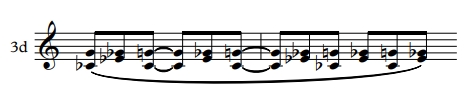
The outline of this repeated tail (3c) gives rise to the theme which appears in its fullest form at the end of the exposition (3d) and leads to the development – I give this theme the name ‘connecting theme’ because of this function.

page1

page1

The fourth (mus. ex. 4a) is the simplest – a rising second. Like the rising semitone of Vers la flamme op. 72, it has the quality of a primal impulse. Stated three times in the introduction, it grows into the principal theme of the Allegro agitato (mus. ex. 4b), with which the cascading fourths which are a feature of the Eighth Sonata are associated.[32] They constitute, not a simple descent, but a double curve, representing a hint of a whirlwind or eddy. It is tempting, and may be helpful in interpretation, to attach to them a phrase from Scriabin’s notebook of 1904–1905, ‘the trembling of life’.[33]

page1

With the exception of the tragic theme (ex.2b) which appears in the position of the second subject, the themes in Sonata No. 8 are unusually abstract and shorn of personal expressive value. This is certainly as intentional as the contrast between lyrical theme and aphoristic motif in the Sixth Sonata. The repeated ‘tail’ of theme 3 (mus. ex. 3c) and the up-and-down of the connecting theme 3d, closely related to it, call to mind the movement of branches in the wind or plants in the water. The first phrase of the principal theme of the allegro agitato (ex. 4b), developed from the primal motif of a rising second stated in the introduction (4a), describes a perfect fifth – in outline it is essentially a Naturthema. The detail of this first phrase, set in triads, like the prestissimo volando theme of the Fourth Sonata, gives us the exhilaration of arising life:[34] two pulsing rising seconds, and a third rise which rests for a moment on a syncopated raised fourth before arriving at the fifth. The corresponding phrase at bar 32-34, significantly, ends with a semitone drop (marked ‘a’), again syncopated (4c): an anticipation of the downward curve of the ‘tragic theme’, as if the beginning of life contained the seeds of its ending.

The forceful, fully expressed form of the ‘tragic theme’ appears at bar 88, marked ‘Tragique’, in the position of second subject. Of this passage Scriabin remarked:

‘But here I have a change of mood in the course of one phrase […].Tragic… but out of it is born such dissolution…suddenly…’[35]

Scriabin’s second subjects were highly significant from the beginning: we may think of the uplift of the second subject in the First Sonata or the consolation of the second subject in the Fantaisie. Later, perhaps under the influence of the gendering of themes in the writing of A. B. Marx,[36] they came strongly to represent a feminine principle: the second subject in the Sixth Sonata is the only lyrical theme in a work whose ideas are markedly laconic. In the Ninth sonata the second theme represents a ‘slumbering sanctuary’, in Scriabin’s own words.[37] Both these themes undergo transformation, as does the second subject of the Tenth, which reappears as a blazing vision of the sun. In the Eighth the role of the second subject undergoes further modification: rather than being acted upon, as in the earlier sonatas, it has pivotal significance in the musical narrative.

Stefanie Huei-Ling Seah, following a hint from Faubion Bowers on the associations in the Russian language to the word ‘tragic’, suggests that in this moment ‘the major tenth ascent may be understood as being heroic prior to the despair of the semitone descent from the G apex to the G flat […]’[38] This suggestion we may associate with the remarks of Valentina Rubtsova on the Poème tragique, op. 34, which she associates with the ‘self-assertion’ of the Poème op. 32 no. 2. The descending phrases of the middle section of the Poème tragique she connects with the ‘theme of protest’ in the Poem of Ecstasy; this section, with its downward-leaping phrases from the trombones, is marked tragico.[39] In other words, this is a matter of a heroic protest: in a scenario familiar from the Poem of Ecstasy, the will has met with an obstacle to its progress. But here the following events are very different from the struggle which ensues in the Poem of Ecstasy: to repeat the quotation  from  Scriabin  himself,  ‘from  it  is  born  such  dissolution …immediately’.[40] Struggle is not Scriabin’s preoccupation in this piece, though we may find elements of opposition in the development section. The two sections of enchanted tranquillity (Meno vivo, b.173-185 and 242–263), surrounded by agitated moods, bring to mind a stanza from the Preliminary Action:

Only through the foam of sensuality is it possible to penetrate
Into that secret realm where the treasures of the soul are
Where, having grown sick of the predilections of the agitated soul
The holy one is blissful in radiant stillness. [41]

Viktor Del’son suggested that the Sixth and Eighth Sonatas shared features of

strongly abstracted expressions of the elemental forces of nature, a reflection of the world surrounding us as one of the manifestations of the cosmos, of the All. [42]

Pavchinsky associated the ‘tragic theme’ in its situation amongst the other more abstract themes with the idea of

[…] a hero amid the agitated night before a thunderstorm, with its gusts of wind and threatening indistinct sounds carried towards us.[43]

But, bearing in mind the early evidence of Gunst that

[…] the music of Scriabin, being the embodiment of a certain experience, […] never by any means contains within itself any kind of hint of programmicity in the generally accepted meaning of this word […][44]

it may be preferred to look at the content of the exposition in the Eighth Sonata in a more abstract way, as the emergence of life, beginning agitatedly (b.21­–25), gaining momentum and reaching its aim of joy at b. 46 (joyeux); the chain of intervals in the theme of dissolution is extended to a full octave at b. 52–55. (Mus. ex. 5; Pavchinsky gave this passage the name ‘theme of upflight’.)

page1

At bar 88 the stage of consciousness and protest is reached[45] and the final stage of dissolution or dematerialisation, like that which ends the Preliminary Action,[46] ensues with one of Scriabin’s finest passages of twittering and flight, the themes 1, 3 and 2 without its rising first member all being present (b. 96–117). All this may be regarded as forming a final group in the exposition, and it is theme 2 in its shortened aspect which has the last word, here as at the conclusion of the sonata. (Presenting only the downward element of theme 2, omitting what Seah calls its ‘heroic’ aspect, robs it of its pathos. Scriabin knew the value of adding or subtracting a few notes at the beginning of a theme: the Poème-Nocturne’s first theme lacked its anacrusis in manuscript, as well as in the list of ‘themes for sonatas’ compiled by Scriabin,[47] but now that anacrusis seems utterly indispensable to the enigmatic character of the music. The ‘theme of will’ in the Poem of Ecstasy is first stated early in the work without its first three rising notes.) The pattern of events in the exposition is repeated in the recapitulation, while the coda may be said to concentrate on the stage of dematerialisation, which happens twice in quick succession ­– corresponding, perhaps, to Blavatsky’s theory of repeated cycles of existence and to Scriabin’s theory that time would speed up as the Mystery approached.[48]

Scriabin, time and the formal plan of the Eighth Sonata

Scriabin expressed to Sabaneev his belief that music could ‘enchant time’.[49] He expressed himself similarly concerning the Prelude op. 74 no. 2, which shows a repeating, circular form, ‘as if it sounds for ever’. [50]  The Two Dances, op. 73, show the same tendency, which may have started with the Fifth Sonata ­– but perhaps even earlier, with the ‘framed’ structure of the youthful Sonata-Fantasy. The literary Poem of Ecstasy,[51] as well as Scriabin’s belief in repeated manvataras,[52] systematises this circular or spiralling principle, as does the symphonic poem. The sensation of listening to, for example, a Beethoven symphony, or to the first movement of Chopin’s B minor sonata (cited above), is a linear one of great purposefulness, and Chopin’s formal innovation (also described above) increases this linearity. Scriabin’s view of time and space, though, was a very different one; he regarded the present moment as a border between two non-existent worlds: the past, which has gone, and the present which has not yet come.[53]

A part of Scriabin’s ideas of time may have been influenced by the writing of Henri Bergson. Bergson’s Essai sur les données immédiates de la conscience first appeared in 1889. We do not possess evidence that Scriabin read this book, though we do know that he studied a paper by Bergson given at the Geneva Congress of Philosophy in 1904. Boris Pasternak recounts in Safe Conduct the importance of Bergson amongst students at Moscow University in the early years of the century.[54]

Bergson’s Essai contains a famous account of the way that humans mentally ‘construct’ the passage of time:

nous projetons le temps dans l’espace, nous exprimons la durée en étendue, et la succession prend pour nous la forme d’une ligne continue ou d’une chaine […].[55] We project time into space, we express duration in length, and succession takes on for us the form of a continuous line or of a chain…

Bergson’s passage refers to the way we perceive a succession of notes as a coherent melody. The same process applies in apprehending the form of a piece of music. The English novelist E. M. Forster wrote about literary form in visual-geometrical terms, similar to those used by Scriabin; and he had this to say about musical form:

Is there any effect in novels comparable to the effect of [Beethoven’s] Fifth Symphony as a whole, where, when the orchestra stops, we hear something that has never actually been played?  […] this new thing is the symphony as a whole […].[56]

It is through memory that we perceive form,[57] and memory is conditioned by time. The form itself, though, is perceivable as a static entity. It is this static aspect, ‘outside time and space’, to which Scriabin moves ever more closely, both in his musical language[58] and in the formal process.[59]

Although he worked at the piano while composing, Scriabin disapproved of improvisation: ‘This is not art, because it cannot be formed […]’[60] Here we may turn to another literary figure, T. S. Eliot, for illustration and clarification:

Words move, music moves
Only in time; but that which is only living
Can only die. […]Only by the form, the pattern,
Can words or music reach the stillness […].
And the end and the beginning were always there
Before the beginning and after the end.
And all is always now. […][61]

Scriabin’s ‘pattern’ has been accounted for in different ways, most notably by Pavchinsky [62] and the French writer Manfred Kelkel.[63] Both draw attention to the high degree of symmetry in Scriabin’s design; Kelkel writes:

Toute la 8ème sonate est structurée des débuts aux extrêmes (Introduction – Coda) comme un miroir à doubles facettes […][64] The whole eighth sonata is structured from the beginning to the extremities (Introduction–Coda) like a mirror with double facets…

Of the outermost element, the thematic correspondence of the slow introduction with the accelerating, dancing coda, Pavchinsky writes:

the most extended arc of the form on the second level [see above] is represented by the co-relation of introduction and coda, where the variation of the fundamental theme translates the images of the introduction from their ‘languorous’ reflection and enigmatic character into the sphere of flight and of pantheistic dissolution.[65]

The correspondence of exposition and reprise, normal in a sonata, needs no comment. It is in the development section that opinions vary. And it is important to stress that it may not be possible to arrive at a single conclusive answer. Musical functions remain fluid and multivalent, susceptible to varying interpretations – each of which may have something to contribute.

Pavchinsky, whose analysis both of harmony and form is based on traditional functions, finds within the development section two sections (b.174–213 and 242­–291[66]) which are in the relationship of exposition and reprise ­– a ‘sonata without a development’[67] within a sonata. Kelkel, basing his analysis on the metrotectonics of Georgii Konyus, proposes three sections: b.118–173, 174–263, 264–319.[68] My own analysis is based on the experience of learning to play this enormous continuous movement, looking within it for meaningful correspondences between sections which aid memory, comprehension and orientation. Taking the hint from Pavchinsky’s reference to an arch, I propose that what Pavchinsky calls the second level of the form ­–  the background level ­– is a principle of symmetry approaching that of a great  arch. We have established that the outmost layer is formed by the introduction (1–21) and the coda (429–499), which are themselves in the relation of exposition and transformed recapitulation. The coda is itself symmetrically built: b. 429-448 are concerned with the ‘theme of tragedy’ and 449–464 with the ‘theme of dissolution’. These two sections are repeated in b.465–482 (transposed up an augmented fourth) and 483–494 (at the original tonality, but with the two upper voices reversed in position.) The last five bars restate the ‘theme of tragedy’ without its upward-leaping member, as at the end of the exposition (114–118) and of the recapitulation (408–416). Once again the repetition is threefold. The second layer in the arch is formed by the exposition and recapitulation (22–121, 320–428) and the third by sections 2 and 4 of the development (158–213, 226–291). (Diagram 1).

ans_dia1_eng265

Diagram 2 shows the structure of the development. There are five sections. The first is symmetrical in itself: an eighteen-bar structure built on the first theme followed by the ‘theme of tragedy’ is repeated one tone lower. The second and fourth sections match and form a symmetrical pair around a twelve-bar connection.; section 4 is transposed up a minor third from section 2. 2i is built from the tragic theme in combination with theme 3 and the connecting-theme. In 4i these elements are joined by the ‘trembling of life’, making this one of the most complex contrapuntal textures in the work. 2ii and 4ii (Meno vivo) are based on theme 4 combined with a calmer version of the descending fourths, (in quintuplets and single notes). 4ii is extended via a three-fold repetition of the end of the theme. 2iii and 4iii (Tragique. Molto più vivo)  are built on the ‘theme of tragedy’ and the connecting-theme.

The connecting sections, 3 and 5 (in dance-flight mode) start very similarly. 5i and ii are again a minor third higher than 3i and ii.  In 3ii and iii the ‘twittering’ alternates with ‘calls’ (the three rising notes of the ‘theme of tragedy’) and with the falling fourths from the ‘trembling of life’. 5ii and iii reproduce the music of dissolution near the end of the exposition (from b.96), which will be heard again from b. 394 near the end of the recapitulation. 3ii and iii hint at this music. 5 iv and v give the ‘theme of upflight’ from b. 52–56 plus a triple call (the rising fourth is enharmonically the same as the opening interval of the piece, the first two notes of the ‘theme of dissolution’) and four bars of  invocational rhythm reminiscent of the connection-theme. This passage, perhaps the most dramatic, ushers in the recapitulation which, starting pianissimo, is very far from the climactic ones in the Sixth, Seventh and Ninth Sonatas – here is a real drop in tension.

ans_dia2_eng266 2 (3)

The ‘triple’ principle in the Sonata has been mentioned. To bring together examples of this element: theme 3 is stated twice three times  (plus twice more) in the introduction; the two entries of the rising second (ex. 4a) in bars 5 and 13­–14 are echoed at the beginning of the Allegro agitato, and the full theme 4, starting with another rising second, follows immediately. At the section marked Tragique there are three falling phrases in b. 92–95 before dissolution sets in. The repetitions of the falling tail of the ‘theme of tragedy’ in the sections marked Tragique. Molto più vivo are, like those of the ‘motive of languor’ in the introduction, twice three and then two more. These set off a section of ‘flight’ each time. Section 4ii is extended to give a triple repetition of the end of theme 4, which sets off the second of the Tragique. Molto più vivo sections.

These triple repetitions, and the high level of repetition of themes and sections in the sonata, help to establish the hypnotic atmosphere of the work which has been mentioned, as do the repetitions on a smaller scale in the Prelude op. 74 no. 2, and the triple repetitions are solemn and ‘magical’ no less than in Mozart’s Magic Flute. The design of the Eighth Sonata, while far from mechanical in its geometry, has reached the highest pitch of symmetry, and as we travel through the symmetries we  feel we have lost touch with chronological, linear time, and have entered a realm where, to paraphrase Scriabin, ‘time has been enchanted’. ‘All is always now.’

[1] V. V. Rubtsova, Preface to edition of sonata no. 8. Munich. 2007.  G. Henle. p. [III].

[2] Carl Dahlhaus, “Struktur und Expression bei Alexander Skrjabin” (1972). In Carl Dahlhaus: Schönberg und andere, gesammelte Aufsätze über Musik. Mainz, Schott, 1978, p. 231.

[3] Hans Keller, Music, Closed Societies and Football. London, Toccata Press, 1974/86, p. 136–138.

[4] Più, ‘more’, is Skryabin’s marking, glossed in the new Russian complete edition as Più mosso. It is arguable, though, that this marking means the performance should be more intense in all aspects – simply ‘more’.

[5] A. V. Kashperov (compiler, ed. and commentary), A. N. Skryabin. Pis’ma [letters]. Moscow, Muzyka, 1965/2003. Letter no 381, p. 343.

[6] L. L. Sabaneyev, Vospominaniya o Skryabine [Reminiscences of Skryabin] (1925). Moscow, Klassika XXI, 2003, p. 122.

[7] S. E. Pavchinsky, Sonatnaya forma proizvedenii Skryabina [The sonata form of works by Skryabin]. Moscow, Muzyka, 1979, p. 6–7. Gottfried Eberle, “Ich erschaffe dich als vielfältige Einheit”, Alexandr Skrjabin und die Skrjabinisten, Musik-Konzepte 32/33. Munich, 1983, edition text+kritik, p. 43.

[8] E. P. Meskhishvili, Fortepiannie sonaty Skryabina [the piano sonatas of Skryabin]. Moscow, Sovetskii kompozitor, 1981, p.172. Quoted by E. Mikhailov, “Vos’maya sonata A. N. Skryabin: popytka analiza” [Skryabin’s Sonata no. 8: attempt at an analysis], Uchenye zapiski, 8/1. Moscow, Skryabin Museum, 2016, p. 75 n. 14.

[9] Elena Gnesina, Ya privykla zhit’ dolgo… [I am used to living a long time…]. Moscow, Kompozitor, 2008, p. 55.

[10] Kashperov, Pis’ma, letter no. 22, p.68. The ‘middle’ latitudes are between 50 and 60 degrees north and south.

[11] V. Del’son, Fortep’yannye sonaty Skryabina [Skryabin’s piano sonatas]. Moscow, Muzgiz, 1961, p.40–44. Daniel Bosshard, Thematisch-chronologisches Verzeichnis der musikalischen Werke von Alexander Skrjabin. Ardez, Ediziun Trais Giats, 2002, p. 154–159, 162. V. V. Rubtsova, prefaces to editions of sonatas nos. 8–10. Munich, G. Henle, 2007, 2010, 2011.

[12] S. Pavchinsky, “O krupnykh fortepiannykh proizvedeniyakh Skryabina pozdnego perioda” [On Skryabin’s large-scale piano works of the late period] in S. Pavchinsky, ed. and compiler, A. N. Skryabin. Sbornik statei [anthology of articles]. Moscow, Sovetskii kompozitor, 1973, p. 449.

[13] Alfred J. Swan, Scriabin. London. J. Lane The Bodley Head, 1923, p. 106.

[14] V.V. Rubtsova, preface to the Henle edition of Sonata no. 8.

[15] H. P. Blavatsky, The Secret Doctrine. Vol. II, Cosmogenesis. London, The Theosophical Publishing Company, 1888, heading to p. 607.

[16] Sabaneyev, Reminiscences, p. 157.

[17] Simon Nicholls and Michael Pushkin, trans., annotated Simon Nicholls, The Notebooks of Alexander Skryabin. New York, Oxford University Press 2018, p. 85.

[18] Op. cit. p. 295.

[19] Cf. “A Note by Boris de Schloezer on the Preliminary Action.” Nicholls and Pushkin, The Notebooks of Alexander Skryabin, p. 47.

[20] H. P. Blavatsky, The Secret Doctrine, vol. II, p. 580­­–581.

[21] Sabaneyev, Reminiscences, p. 162.

[22] Op. cit., p. 263.

[23] Tamara Levaya, “Skryabinskaya ‘formula ekstaza’ vo vremeni i v prostranstve” [Skryabin’s ‘formula for ecstasy’ in time and in space], in A. N. Skryabin: chelovek. khudozhnik. myslitel’ [the person, the artist, the thinker]. Moscow, Skryabin Museum, 1994, p. 101.

[24] ‘Extra-tonal’ is a term used by Russian commentators of Skryabin’s era, Sabaneyev for example, to denote a harmonic style where the tonic is distantly felt as an attraction but resolution is avoided. Stretches of Rimsky-Korsakov’s Kashchei the Deathless (1901-1902) are ‘extra-tonal’.

[25] Sabaneyev, Reminiscences, p. 295.

[26] Cf. E. Mikhailov,  op. cit., p.76. He quotes Skryabin: “Harmony and melody are two sides of a single essence”. Mikhailov comments: ‘[…]Has not the embodiment of a specifically Skryabin space-time been revealed here, more exactly, the translation of time into space?’ This brings to mind the words of Gurnemanz to Parsifal during Act One of Wagner’s opera: Zum Raum wird hier die Zeit. [Here time becomes space]. Skryabin’s critical attitude to Parsifal, expressed to Boris de Schloezer, shows that he knew the work. Nicholls and Pushkin, p. 38. Wolzogen’s Leitfaden [thematic guide] to Parsifal was in Skryabin’s personal library.

[27] Мikhailov op. cit., p. 74.

[28] B. Fokht. Filosofiya muzyki A. N. Skryabina [Skryabin’s philosophy of music]. In Skryabin: chelovek. khudozhnik. myslitel [the person. the artist. the thinker]  p. 186. Nicholls and Pushkin p.195.

[29] Nicholls and Pushkin, op. cit., p. 106. Notebook of 1905–6.

[30] Hegel: ‘[…] the level and excellency of art, in attaining a realization adequate to its idea, must depend on the grade of inwardness and unity with which Idea and Shape display themselves as fused into one’. Bernard Bosanquet, trans., The Introduction to Hegel’s Philosophy of Fine Art [Aesthetik]. London: Kegan Paul, Trench, 1886, p.138. Skryabin recommended Hegel in a letter to Margarita Morozova, 3/16 April 1904. Kashperov, op. cit., pp. 307–8, letter 322. Nicholls and Pushkin p. 237.

[31] Gottfried Eberle, “‘Ich erschaffe dich als vielfältige Einheit’”. In Aleksander Skrjabin und die Skrjabinisten. Heinz-Klaus Metzger and Rainer Riehn, eds. Musik-Konzepte 32/33. Munich: edition text+kritik, 1983, p. 48–49.

[32] My colleague, the distinguished pianist and professor Dina Parakhina, has remarked that these descending fourths need to be treated always as a release  from  the tension built in the ascending  theme they follow. They need to be played with great lightness and a certain irreality, and are always marked to be pedalled – a super-clear articulation is essential, of course, but this is not the main requirement.

[33] Nicholls and Pushkin, p. 66.

[34] At the basis, however, lies the desire for absolute bliss. Life is upsurge. Nicholls and Pushkin, p. 113, Skryabin’s own footnote in the notebook of 1905–6.

[35]  Sabaneyev 1925/2003, p. 295.

[36] “Scriabin’s Symbolist Plot Archetype in the Late Piano Sonatas”, Susanna Garcia,

19th-Century Music, Vol. 23, No. 3 (Spring, 2000), p. 273-300.

[37] Sabaneyev, Reminiscences, p. 162.

[38] Stefanie Hue-Ling Seah, “Alexander Scriabin’s style and musical gestures in the late piano sonatas: Sonata no. 8 as a template towards a paradigm for interpretation and performance.” A dissertation submitted for the degree of Doctor of Philosophy, University of Sussex, 2011. p.116. http://sro.sussex.ac.uk/6959/1/Seah%2C_Stefanie_Huei-Ling.pdf, accessed 5/10/2016.

[39] V. V. Rubtsova, Aleksandr Nikolaevich Skryabin. Moscow, Muzyka, 1989, p. 223.

[40] The word ‘immediately’ suggests to the present writer that the diminuendo made by many players in the repeated falling phrases, not marked by Skryabin, is not appropriate here: the transition to ‘dissolution’ should be startling and instantaneous ­– a breaking-through into a different mode of existence.

[41] Nicholls and Pushkin, p.145.

[42] V. Del’son, Skryabin. Ocherki zhizni i tvorchestva [outlines of life and creative work]. Moscow, 1971, Muzyka, p. 322.

[43] Pavchinsky, “On Skryabin’s large-scale piano works”, p. 449.

[44] E. Gunst. A. N. Skryabin i ego tvorchestvo [Skryabin and his creative work]. Moscow, 1915, Jurgenson, p. 32.

[45] Skryabin considered the emergence of consciousness to have a profound effect on the material of the Cosmos. Nicholls and Pushkin, p.107–108.

[46] Op. cit., p. 158.

[47] Both these manuscript sheets are in the Glinka Museum, Moscow.

[48] Sabaneyev, Reminiscences, p.  250.

[49] Op. cit. p. 57.

[50] Op. cit. p. 313.

[51] Nicholls and Pushkin, p. 115–125.

[52] Sabaneyev: Skryabin. Moscow, 1916, Skorpion, p. 48.

[53] Nicholls and Pushkin, p.76.

[54] ‘The majority were enthusiastic for Bergson’. Boris Pasternak, Safe Conduct, trans. Beatrice Scott. In: Boris Pasternak, Prose and Poems, ed. Stefan Schimanski, intro. J. M. Cohen. London, Ernest Benn, 1959, p. 32.

[55] Henri Bergson, Essai sur les données immédiates de la conscience, chapter II, “De la multiplicité des états de conscience: l’idée de durée”. Paris, Félix Alcan, 1889, p. 76.

[56] E.M. Forster, Aspects of the Novel. London, 1927/1969, Edward Arnold, p. 154.

[57] Paul Badura-Skoda, essay on the Hammerklavier sonata. Paul Badura-Skoda, Jörg Demus, Die Klaviersonaten von Ludwig van Beethoven. Wiesbaden, 1974, F.A. Brockhaus, p.175.

[58] […] the effect of the harmonic progressions characteristic of the later music is always to weaken the relationship between chords which precede and follow, and this is also a temporal matter. Hugh MacDonald, “Skryabin’s Conquest of Time”, Otto Kolleritsch, ed., Alexander Skrjabin, Graz,1980, Universal Edition/Institut für Wertforschung, p. 62.

[59] […]the renunciation of unidirectional striving […] the locking of the “running spiral” into a spherical form […] Tamara Levaya, “Skryabin’s ‘formula for ecstasy’” (present version from the 2005 edition.) Quoted from E. Mikhailov, op. cit., p. 75.

[60] Sabaneyev, Vospominaniya, p. 254.

[61] T. S. Eliot, “Burnt Norton”, Four Quartets, London, 1944, Faber & Faber, p. 12.

[62] Pavchinsky, The Sonata Form, p. 198–206.

[63] Manfred Kelkel, Alexandre Scriabine: sa vie, l’ésotérisme et le langage musical dans son œuvre. Paris, 1978/1984, Librairie Honoré Champion, livre III p. 146–150.

[64] Kelkel, op. cit., livre III p. 150.

[65] Pavchinsky, op. cit., p. 206.

[66] Pavchinsky does not give bar numbers; they are supplied by the present author.

[67] Pavchinsky, op. cit., p. 204.

[68] G. E. Conus (Konyus) (1862–1933) was a pupil of  Arensky and taught Skryabin at an early age. His analytical method, involving the graphic representation of sections of a composition according to bar numbers, was published in the journal Muzykal’naya kul’tura, 1924 no. 1 (“Metro–tektonicheskoe razreshenie problem muzykal’noi formy”) [A metro-tectonic resolution of the problems of musical form]  and appeared in book form in the year of his death. The attraction of this method for Kelkel is double: the early teacher/pupil relation between Konyus and Skryabin and the evidence in many manuscripts of Skryabin’s calculations involving bar numbers. The bar numbers of Kelkel’s analysis, in which he counts the number of bars in each section, are supplied by the present writer. Kelkel takes the development as starting with what I have called the ‘cadence- or connecting theme’ at b.118, apparently for reasons of mathematical proportion.

The Notebooks of Alexander Skryabin

The Notebooks of Alexander Skryabin – translated by Simon Nicholls and Michael Puskin with annotations and commentary by Simon Nicholls and foreword by Vladmir Ashkenazy 

LCCN2017044481 (ebook)
ISBN 9780190863661 (hardcover)

“truly an essential addition to Scriabin literature” BBC Music Magazine

51IqKo5QVEL._SX327_BO1,204,203,200_ (1)

Alexander Skryabin kept private notebooks in which he noted down thoughts occurring to him, building into a world-view which had a radical effect on his creative work. For the first time, these notebooks have been translated into English in full and with the introductory material of the original 1919 publication, giving an insight into Skryabin’s creative process and the conditions of his last two years of work. The combination of Simon Nicholls, a musician, and Michael Pushkin, a professional Russianist, ensures accuracy. The notebooks are complemented by letters and other relevant material and there is a biographical section and an analysis of the Poem of Ecstasy, showing how Skryabin’s poem corresponds with the orchestral score. A section on Prometheus deals with the principles of colour/sound relations in the work and their relation to its form. Research is based on original Russian material from sources close to the composer, and there are illustrations from the archives of the Skryabin Museum, Moscow.

“…his message has a meaning inherently connected with our spiritual existence.”

Vladimir Ashkenazy

“truly an essential addition to Scriabin literature”

BBC Music Magazine

“A splendidly researched volume, and an endlessly fascinating piece of scholarship. I learned a great deal from it, and it will prove essential to anyone wishing to probe deeper into Skryabin’s world. The book is an immensely valuable addition to our understanding of every aspect of this most enigmatic of Russian composers.”
Marc-André Hamelin

“Brings to life…the composer’s secret journals in fresh, modern translations”.
Lincoln Ballard

The Notebooks of Alexander Skryabin can be purchased here.

Igor Zhukov: obituary

Igor Zhukov, a leading Russian pianist who was also a conductor and a recording engineer, died in Moscow on January 26, 2018. He was 81, having been born in 1936 in Nizhny Novgorod (Gorky in the Soviet era); his family moved to Moscow a year after he was born. He studied at Moscow Conservatoire with Emil Gilels and Heinrich Neuhaus, and won the second prize for piano in the Long-Thibaud competition of 1957. He was a pianist of profound insight, which was vividly conveyed by an enormous, seemingly infallible technical capacity. His authoritative recording of all ten Scriabin sonatas was the first complete recording to be made in Russia, and was issued in the composer’s centenary year of 1972. It aroused great interest in the West, and has been reissued on CD; but Zhukov’s formidable discography contains, besides other works by Scriabin, a wide repertoire ranging from Bach to Prokofiev, including the Brahms second concerto, the Medtner first concerto, and all the music for piano and orchestra by Tchaikovsky. The Sonata op. 22 and the Quintet by Medtner were also recorded by Zhukov. He performed and recorded in a trio with the violinist and cellist Grigory and Valentin Feigin, and proved to be an outstanding partner to the soprano Natalia Gerasimova in a disc of songs by Glinka and Rachmaninov.

As conductor Zhukov worked with the Chamber Orchestra of the Ulyanovsk Philharmonia, New Moscow Chamber Orchestra and, more recently, with another chamber orchestra, the Nizhny Novgorod Soloists.

As a human being Zhukov was warm, generous, hospitable and hugely enthusiastic and knowledgeable about all aspects of music. His enormous repertoire as pianist and conductor was predominantly Russian and German, but it is a testimony of his breadth of sympathies that he conducted moving and eloquent performances, with the Nizhny Novgorod Soloists, of works by Elgar and Britten.

Tracks from Zhukov’s recorded archive are being assembled on the official website of the Nizhny Novgorod Soloists (Russian language): http://solistynn.ru/personalii/dirizhyory/igor-mihailovich-zhukov/